Hydroelectric
Turbine types
Turbines with different shapes of the runners (the turning part of a turbine that interacts directly with the flowing water) and different sizes are used in hydroelectric systems. The major turbine types include the Francis turbines, propeller turbines and Pelton turbines.
Francis turbines
This is the most common turbine type in hydroelectric stations. The Francis turbine is a radial-flow turbine with water flowing in a radial direction inward over the curved runner blades toward the centre of the turbine. Francis turbines are suitable for hydroelectric systems with water heads between 2 metres to 200 metres, and the efficiency can be over 90%.
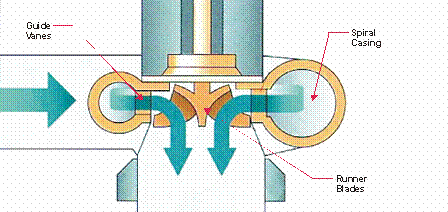
Above: Typical Francis turbine
Propeller turbines
The propeller turbine is an axial-flow turbine with propeller-like runner having three to six runner blades depending on the design water head. It operates like a boat propeller but in a reverse mode. Propeller turbines are usually applied in systems with water heads between 2 metres and 30 metres. One type of propeller turbine called the Kaplan turbine has adjustable blade pitch, and it can achieve high efficiency under varying power output conditions.
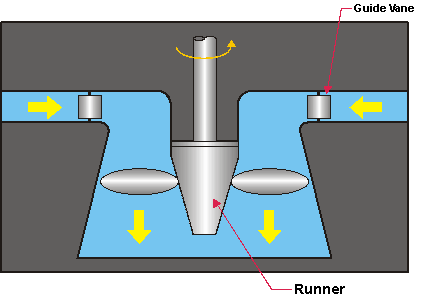
Above: Typical propeller turbine
Pelton turbines (Pelton wheels)
A Pelton turbine consists of a set of buckets or cups mounted around a hub. Pelton turbines are not immersed in water. Instead, a Pelton turbine operates in air with the wheel driven by jets of high pressure water hitting the buckets or cups. Kinetic energy of the water jets is transferred to the turbine. Pelton turbines are applied in sites with large water heads of over 250 metres.

Above: Typical Pelton turbine