Large Wind Turbine
Major types of wind turbines
1) Horizontal axis wind turbine VS vertical axis wind turbine
Based on the orientation of the shaft about which the aerofoil blades are configured, wind turbines can be divided into horizontal axis and vertical axis wind turbines. The rotation axes of horizontal axis wind turbines operate in line with the wind while the rotation axes of vertical axis turbines are at right angle to the wind.
Horizontal axis wind turbines are continuously realigned to keep the rotor in line with wind direction. But this is not required for vertical axis wind turbines as they can harness wind from all directions.
Horizontal axis turbines are the dominant turbine type all over the world.
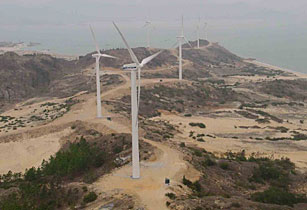
Horizontal axis wind turbine |
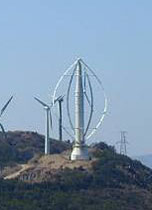
Vertical axis wind turbine |
An upwind wind turbines is a horizontal axis wind turbine with the rotor facing the wind while a downwind turbine is one with the wind blowing from the back of the rotor. The majority of modern large wind turbines are up-wind machines.
2) Single blade, two blade, and three blade machines
The number of blades of a wind turbine is determined by various factors including aerodynamic efficiency, complexity, cost, noise and aesthetics. Large wind turbines have been built with single blade, two blades or three blades.
Wind turbine of fewer blades need to rotate faster to get more interaction with the wind so as to extract more energy from it, and hence they are noisier. When the number of blades are too many, they can interact with each other and hence reduce the overall efficiency of the turbine. Nowadays, turbines with three blades are the dominant turbine type. Aesthetically, a three blade turbine looks more balanced and pleasing.